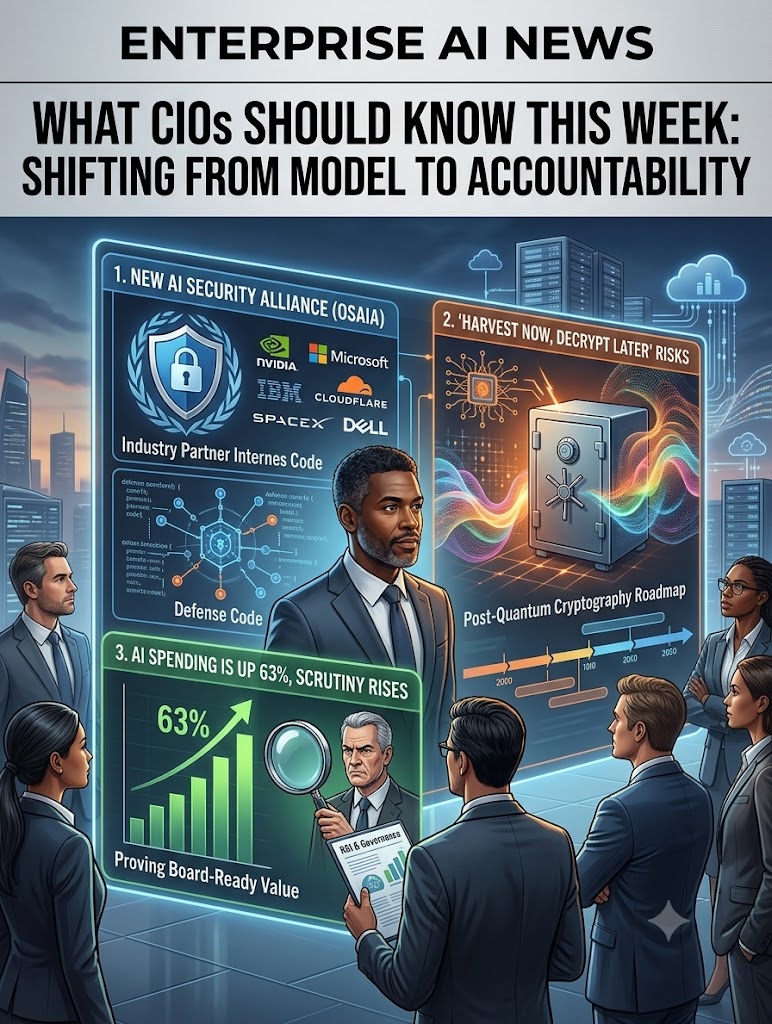
Enterprise AI News
What CIOs Should Know This Week
The AI conversation has quietly shifted from "which model?" to "who's accountable when it fails?" This week's headlines make that shift explicit — a new industry security alliance, fresh IPO activity, layoffs tied directly to AI restructuring, and mounting pressure on CIOs to prove ROI in board-ready terms. Here's what's worth your attention.
1. AI Security Just Got an Industry Alliance
On July 27, Nvidia launched the Open Secure AI Alliance (OSAIA) — a coalition building open-source tooling to detect and defend against AI-driven attacks. Founding members include Microsoft, IBM, SpaceX, Adobe, Cloudflare, CrowdStrike, and Dell. Notably absent: OpenAI and Anthropic.
Why it matters: As enterprises push more autonomous agents into production, the industry is acknowledging that defense can't be a single-vendor problem. If you're running agentic workflows without a shared threat-detection layer, this alliance is worth tracking as a source of frameworks — not just headlines.
Do this: Ask your security team whether your current AI vulnerability disclosure and evaluation practices could plug into an open framework like this one, rather than staying vendor-siloed.
2. "Harvest Now, Decrypt Later" Isn't Theoretical Anymore
Quantum-decryption risk has moved from a future-state slide to an active concern. Security researchers confirm that adversaries are already capturing encrypted banking and government data today, betting they'll be able to decrypt it once quantum computing matures.
Do this: If post-quantum cryptography migration isn't on your 18-month roadmap, it needs to be. Waiting for "quantum-ready" mandates from regulators will put you behind, not ahead.
3. AI Spending Is Up 63% — And So Is Scrutiny
Global AI spending is projected to jump roughly 63% to $64 billion in 2026, and boards are responding by demanding sharper accountability. The recurring theme across CIO commentary this week: AI can clearly do the work — the harder question is whether it can do it economically. Expect more conversations about "token P&L" — treating AI compute cost like a line item with its own margin, not a sunk R&D cost.
Do this: If you don't already have a cost-per-outcome view of your AI initiatives (not just cost-per-token), build one before your next budget review. CFOs are starting to ask for it in that language.
4. Layoffs Are Increasingly an AI-Restructuring Story, Not Just a Cost Story
ServiceNow is the latest major tech company reducing headcount explicitly to fund AI investment — joining a pattern seen across the sector this year. Separately, roughly 26% of senior security executives say AI-adoption pressure has them considering leaving their roles, citing unrealistic timelines and unclear governance ownership.
Do this: If your AI rollout is creating this kind of pressure on your security or platform teams, treat it as a retention risk, not just an execution risk. Burned-out teams under-govern.
5. Cloud Strategy Is Splitting Again
The AI-workload cost and data-sensitivity equation is pushing some enterprises back toward private cloud, even as sovereign clouds and "neoclouds" reshape the provider landscape. The one-size-fits-all public cloud assumption from a few years ago is no longer a safe default for AI-heavy workloads.
Do this: Revisit your cloud placement decisions specifically for AI workloads — not your whole estate. The right answer is increasingly workload-specific, not organization-wide.
6. Governance Evidence Is Now a Survival Skill
A recurring thread across this week's CIO coverage: in a post-breach or regulatory-review scenario, CIOs need documented evidence of risk governance — not just policies that exist on paper. Regulatory scrutiny is intensifying faster than most governance documentation is keeping up.
Do this: Audit whether your AI and data governance decisions are actually being logged and version-controlled, or whether they live in someone's inbox. If it's not documented, it didn't happen — at least not to a regulator.
The Bottom Line
This week's signal is consistent: the industry is moving from AI enthusiasm to AI accountability — on security, on spend, on people, and on governance. CIOs who can answer "prove it" in each of these areas will be the ones setting the pace in the second half of 2026, not reacting to it.

Compiled from industry coverage the week of July 27–31, 2026, including CIOnews, TechTarget SearchCIO, eWeek, and Wavestone's 2026 technology trends analysis. [Complier - Hareesh. E, Consultant and AI Specialist]